Keeping the Lights on in a Room of One’s Own
Say you now have a room of your own. It's a nice place, considering.

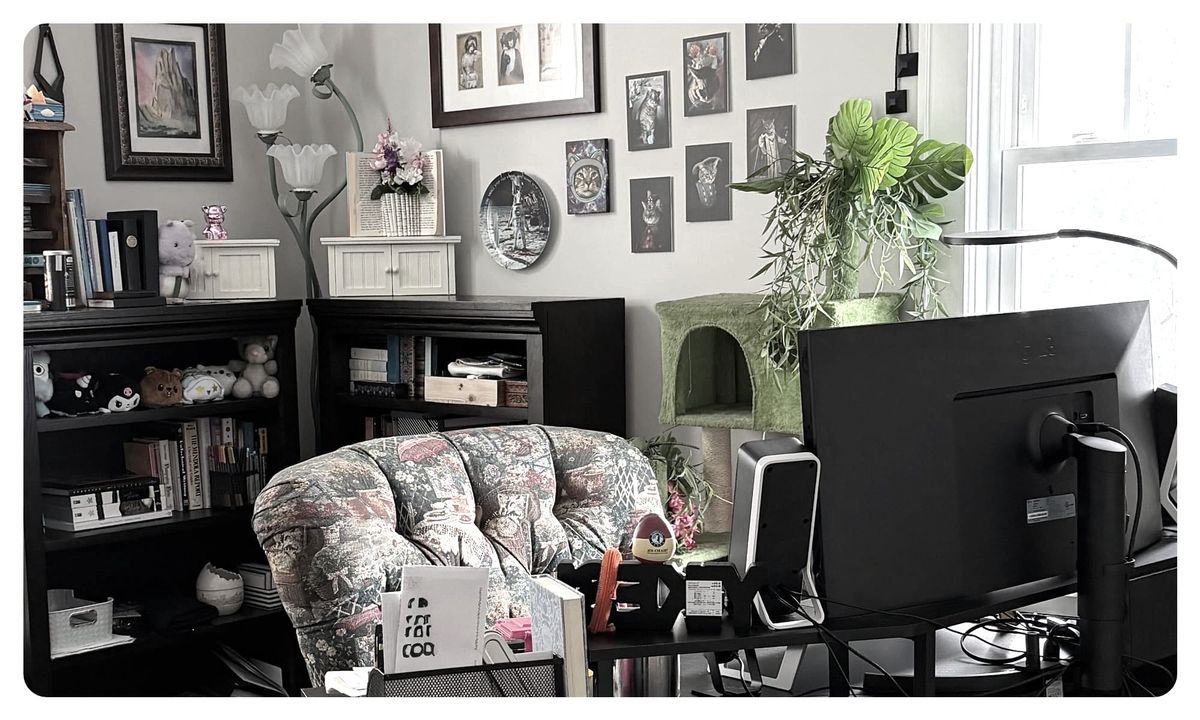
Say you now have a room of your own. It's a nice place, considering.
You ended up working from home during the pandemic. And you're still working from home. You have time to take your kids to school. You have a space you've crafted with your own snacks. You have an office where you can have your own form of quiet to focus.
Maybe you have to go back into the office some days. You haven't been forced back to full time and you’re grateful for that. You dread your days in an open floor plan with the flickering hostility of fluorescent lights.
When they force you back into the office, you'll go back if you want to keep your job. It might be any week now. They've tracked your email usage and you send fewer when you're working from home. They say this means you're slacking off.
On the days you're in the office, you're constantly distracted by people coming to your desk. Your calendar is filled with meetings that could definitely have been an email. You don't speak up much in those meetings.
If you have an opinion and you aren't a man, you're too strident, too bossy. Bluntness is reserved for men so they can be disruptors. They're straight shooters. Their violence is admirable.
You know you have to sneak up on your point so as not to surprise them. You couch your expertise as an apology. You hold your peace when a man uses your work to get a promotion.
You wish you had time to write poetry. The best you can manage is to join the cacophony that echoes from your mother and grandmothers and their great grandmothers. You sing under your breath as you fold laundry and try to figure out what to cook for dinner.
You try to share what it feels like, but you struggle to find the words.
You try, of course. That cry in your chest needs to get out in some way. You make a post online, or a video, trying to share that feeling.
The comments come in, and there they are. You have made your presence known and men have opinions. They can't help it, drawn to it like moths to the flame you light in the darkness. The dust from their wings buries what you were trying to say.
They don’t even need to read what you’ve written to have an opinion about it. They are qualified to have these opinions because they are not women. Their opinions are antiques, polished and affixed like medals of honor to their chests. Sons inherited them from fathers who inherited them from their fathers and grandfathers and their great grandfathers.
You know not to read the comments, and yet you do. There's Paul, with his opinion that a rail-thin model is too fat. There's Andrew, his only comment that "women can't be pastors" when she clearly is. Their comments are vacuous, empty and take all the air out of the room.
When Woolf asks "Are you aware that you are, perhaps, the most discussed animal in the universe?" you smile a little. Your smile isn't a happy one. You wish they'd stop. Or at least talk about something else for a change.
You can't tell them that. You've seen others say it, others who are not men. The words are barely written or said before there's a roar from the chorus: "not all men!"
If you want to avoid this, you must write so that each individual understands you can't possibly mean him. He is the good guy, the protagonist in a world created just for him. You must let him know he is the exception. He hasn't hurt you directly, so therefore you can't possibly mean him.
The women who say otherwise are liars, of course. They just say these things to ruin his life, to ruin his reputation, his chances at a good career. He thinks #MeToo is a weapon not a shield. He can't say anything these days, can he? It's so unfair.
Your fingers pause on the keyboard. Is that thought even worth saying? Even if you speak eloquently enough, you will be silenced by an algorithm. They make it clear you must stay on the gravel path.
You keep scrolling and you read a screenshot of a post from another platform. Someone has said "This" and shared an image from an essay by Virginia Woolf. Your breath catches in your throat.
Millions are condemned to a stiller doom than mine, and millions are in silent revolt against their lot. Nobody knows how many rebellions ferment in the masses of life which people earth. Women are supposed to be very calm generally: but women feel just as men feel.
Your poetry, if you can write it, is written in a rage when you should write calmly. You are at war with your lot and you can write of nothing else.
Even though you have a room of your own, rent is due tomorrow.
We have fought so hard to have a room of our own. Economic freedom has given us space to write, to create, to think, to imagine. Surely we have enough opportunity, training, encouragement to have the income we need to live and write our poetry.
Surely things are better. And they are.
We have fought for them to be.
History still repeats itself. We can draw a line from the men Woolf mentions to those today: Nick Greene, Dr. Johnson, Germaine Tailleferre, any number of men today who feel women doing anything they deem out of place: "is like a dog's walking on his hind legs. It is not done well, but you are surprised to find it done at all." They call us bitches for a reason.
The language we use for our rights is that they are given or granted. Women are granted the right to vote. Women are given the right to own and manage property. We should be grateful for their generosity.
And yet these hard won rights are deleted word by word from documents we have been told are sacrosanct. The fights we thought were over and settled are resurrected. They return with a violence we were not prepared to confront.
There is so much anger by men at those who are not men. It makes no sense to us. We think, as Woolf did, that it seems absurd that these men with all this power should be angry.
Their anger makes us angry, but we understand our anger as Woolf understood hers. It is infuriating to be told again that we are mentally, morally, and physically inferior to men. Our anger is a response to their anger. We understand ours, but we can't understand theirs.
It seems like so much effort to hold that anger, to persist in it day after day and in every situation. So many words are written and said, telling us again and again what they think our place is, what we should look like, how we should behave.
Aren't they tired?
Maybe they are. Maybe that is why they are automating our work.
We have noticed, you see, that these things they are calling Artificial Intelligence aren't replacing the work men do. They're automating the work they have consigned to women. The boring work they don't want to do. The work that isn't glamorous. The work that is just too hard for them.
Let's walk down this dystopic path a little and peek at the man behind the curtain. What happens when our jobs are automated? What happens when they lay off workers supposedly redundant in the face of this new technology? What happens when we lose our jobs and our incomes?
What happens to the room of our own?
Woolf knew we didn't just need a room. We needed an income enough to give us food and bed and every other necessity to live independently. We still need this and we still fight for it.
When we look back at the last century and look at it closely, we see how we have been pushed again and again back into the path they have chosen. We worked in factories and made a decent living when there were no men to do those jobs. When they came back, there was no longer room for us. We became out of place and they told us what our place was.
Are we talking too bluntly here? Have we not first ensured there is no man lurking in the cupboard before we speak plainly?
Woolf speaks for us indirectly when she thinks they might be listening. She searched for the white light of truth and didn't find it. We did too, with similar results.
These days, the truth is that there is no hint of that white light. We are blinded by the red light of their emotions sold as facts, not feelings.
Rational men have no use for emotion. They'll have none of that nonsense in their narrative. They shove their feelings off stage until only their ego remains. Then they stand in the spotlight and claim the light is white and the red is only because of our rose colored glasses. Because we are being too emotional. They ask if we are on our period.
So their emotions hide, visible only under the black light of their actions. We know it's there, we've seen the result. That knowledge comes out in our writing. Our poetry is hidden and heaped with bitterness and resentment. Our novels that could be incandescent are banked by hate and fear and despair.
We can’t afford not to be angry.
I have hidden my emotions in pronouns. You have journeyed with me through stories that aren't new to anyone. We who are not men have raged against those who are. A century after Woolf spoke on the topic of Women and Fiction, I am still saying the same things.
I, we, you – all are repeating ourselves and fighting to be heard.
A hundred years later and my inheritance is still the tears of Florence Nightingale and so many more since her. It is no consolation that I am not alone in this.
Like Charlotte Brontë, I write of myself where I should write of my characters. Even where I am in my life, I am at war with my lot. My "gift is all grown about with weeds and bound with briars." And I am so tired of having a "desire to protest, to preach … to make the world the witness of some hardship or grievance". Woolf says these are hostile to an incandescent, unimpeded mind.
She is not wrong.
When my husband told me he wanted a divorce, he also told me I had a week to move out. My family believed divorce was just as bad as abortion, so I didn't have anyone to help me. The house was in his name, as was the $6,000 he begrudgingly gave me to help me as a new divorcee.
So I moved out. It sucked and I was so angry for so many reasons. But slowly the tension in my chest loosened. It felt like I had finally untangled a knot I couldn't afford to cut. Virginia Woolf's phrase came to me and remained like a prayer.
I had a room of my own.
When my grandmother passed, years before my marriage, she told me to get my degree first. In the wisdom of my 20's I knew I was never going to get married. What she told me didn't mean much at the time.
She passed, and then my grandfather did years later. As he was in hospice, my dad told me that she had tried to get a divorce. Just after the war, my grandmother had taken their newborn son to her mother's house and refused to return. My dad said that it took a lot of pleading on my grandfather's part to get her to come back. He told the story like it was funny, and maybe to him it was.
But it isn’t funny, it’s heartbreaking. I know they got back together.
In her generation, Women had no economic freedom and there were few jobs a single mother could try to apply for. Even if she did, employers would assume that she wouldn't be as fit for a role as any man, married or not. She didn't have a degree, she would be distracted by her child, etc.
I got divorced not long after my grandfather passed away. A decade later, I have a room of my own. I have an income that can support me if I’m careful. But in that same time, Roe v Wade was overturned, horrific stories of abuse have come to light, people like me are objects to be objected to.
The poems today are written by bots owned by corporations led by men. They don’t call themselves Fascists but the input results in the same output. The cycle of history feels like a noose around my throat.
This sounds like I hate men. I don’t. Being genderfluid makes it weird to. But their “I” is not the same as my “I”. Theirs is so alone and isolated. They hold no one in their hearts but their singular pronoun.
They assert. They never embrace.
This is why a century later, we have none of what Woolf hoped we would. My heart broke each time she wrote that maybe now things could be better. It hurts to think of what could be, what should be. It hurts to see the hopes of the past dashed in the present. It hurts when the future seems impossible.
It’s so hard to have hope. And yet I must. We must. You must.
Hope doesn't have to be grandiose.
Hope can be a candle I light to let others know I see them. Maybe you can use it to light a candle of your own. From there, flame after flame, together we can become incandescent.