Denotation and Connotation, Cartomancy edition
Tarot feels more like intellectual symbolism versus how Lenormand feels like emotional symbolism. It's semantics, cartomancy edition.

Growing up in a heavily ritualized form of ceremonial magic (i.e. Roman Catholicism), I find comfort in structured frameworks. Ceremonial magic (also known as high magic) has tools and magic words, inputs and outputs. It feels like software design and that makes my little engineer heart happy.
However, one of the things I have been working on recently is unpacking my reliance on those frameworks and the way they have negatively influenced my life. Letting go of structure can be hard, even if it's proving to be something that is limiting my growth more than assisting it.
Letting go of structure means letting go of the tools I have used to interact with that structure. As such, I've been exploring different ways of interacting with the emotional, wiggly, gooey liminal spaces of our spiritual world. But just because it's wiggly doesn't mean I don't need a way to interact with it. So for this reason, I've been designing another Lenormand deck.
Last year I wrote about using an early version of AI image generation to create a deck pulled from the collective unconscious. With that project, I dove deeper into that world of Jungian theory and the archetypes we use as part of our definition of existence. That project gave me a better insight on how I can use cartomancy to explore the parts of myself that I might not have strict intellectual access to.
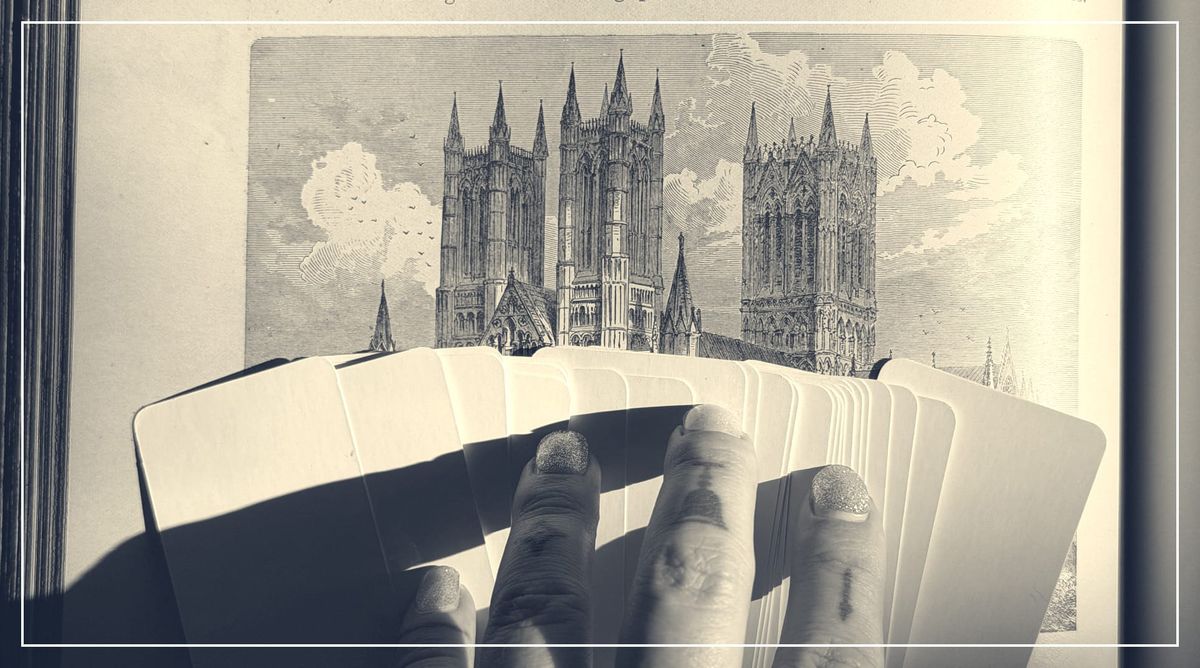
I've also written about how I made a sticker oracle deck. Unlike the Lenormand deck, this one I built entirely on vibes and what images I thought looked cool together. This one is harder for me to use because it has absolutely zero structure. The cards don't have labels or keywords. The only meaning they have is what I bring to the table. But this also taught me something about myself: some days I need at least a little structure for the process of self examination.
Before that, years ago, I designed a tarot deck for writers that also drew on the meaning of the cards in how we tell stories. When I worked on that deck and the associated book, it gave me an opportunity to dive into the history of divination, and in particular how we fold cultural meaning into our ritual tools.
Each time I work on a cartomancy project, the more insight I get into how divination gives us insight into existence and our spiritual nature. This insight gives me more tools in my own personal practice and my own shadow work. So it's not only fun but it's also therapy!
In the past year or so, I have been drifting more towards using Lenormand cards in my daily practice. After using tarot as my primary tool, this is a break from tradition, and perhaps one that I've needed. Structure is helpful in broad strokes work, but the work I'm doing now is based on my emotions and not my intellect. Using a less well structured system helps get my intellect out of the way, removing the definitions to get under it to the gooey underbelly of my emotional state.
This work has led me to consider how the difference between tarot and Lenormand decks is similar to the difference between denotation and connotation. Tarot feels more like intellectual symbolism versus how Lenormand feels like emotional symbolism. It's semantics, cartomancy edition.
First, as a refresher, denotation provides the literal meaning of a word or concept. Connotation is the context, the implied or associated meanings beyond just the literal definition. With denotation, we have a shared starting point (the definition) of a concept. With connotation, we have the nuance of context combined with that definition that gives us the richness of the relationships between the words.
Tarot feels like denotation. There are structured, defined meanings and keywords for the cards. The Empress means growth, Death is transformation, etc. The way I read with them is reliant on the specific and individual definition of each card in a progression of meaning. The reason I use them this way is because of my understanding of the history of tarot.
Over the past several hundred years that we've been using tarot cards for divination, the meanings of the cards have accrued layers of definition. As a bit of a history lesson, one of the people who worked on these definitions was Éliphas Lévi. He spent a lot of his career defining a magical system that became the foundation for many of the rituals of ceremonial magic that would follow (e.g. the Hermetic Order of the Golden Dawn). His work with the tarot was in part to associate the kabbalah with the cards, to work on giving them a denotative structure in his magic system.
After him others like Waite and Crowley associated the cards, suits, and arcana of the tarot with elements of astrology, numerology, and other occult traditions. This has given the tarot a depth of meaning with all the richness of European esotericism. However, it also means that there is less wiggle room in interpretation if one is going strictly by the meaning of the cards.
This isn't necessarily detrimental. One of the benefits of the tarot being so strictly defined is that it provides an excellent framework for interacting with what Crowley calls "a symbolic picture of the Universe"[1]. We can work with this framework to develop our understanding of how the world works and our place in it. If we examine the Major Arcana in order from The Fool to the Universe, we see the story of a journey of growth and discovery. Each card leads to the next, and in our readings, we can use our knowledge of that progression as part of our reading.
This strictness of definition is useful when examining the archetypes of our existence. However, as my spiritual practice has evolved and become less tied to ceremonial magic, I find that I get more use out of systems that are less rigidly defined. My spiritual practice has become a lot less denominative and much more connotative. We sometimes call that connotative practice "woo".
I used to hate woo. It felt too silly, too unstructured. Too full of wide-eyed credulity that was too reliant on faith and not enough of the scientific method. It can still be this, of course, and when that happens, it still makes me feel a little uncomfortable.
However, guess what also makes me uncomfortable? Emotions.
The more work I've done on myself, the more I have come to realize that sometimes it's ok to be woo. It's ok to be silly and look at the world through an unstructured lens. Sometimes that's where the wonder is. It's all about the balance between art and science. You need both to be healthy. Or at least I do.
Enter the Lenormand deck. As I have mentioned before, the Lenormand is a deck of 36 cards that has somewhat fixed meanings for each card (e.g. the Ship means a journey, the Star means hope). Unlike the tarot, Lenormand cards are not meant to be read in isolation from each other. You can use them for this purpose of course (you do you, boo). But this system really shines when you use the cards in relation to each other.
The meanings shift and change when the cards are associated with each other. For example, the Ship can mean a journey, but when combined with the Star, those two meanings merge into the relationship between the two. Thus we get not only the denotation, but also the connotation of hoping for a journey, or perhaps even an optimism about an adventure the person is on. Adding more cards to the story deepens it, giving more context and more opportunities for reflection.
One of the traditional ways to read with a Lenormand deck is Grande Tableau, which means using the entire deck to see how the cards relate to each other, telling a story of association, not a journey of meaning. It's also really fun to lay all the cards out into a story that is different with every reading.
The way each reading morphs with the interaction of the cards is where the benefit lies for my current practice. Exploring the parts of myself that are more gooey and emotional requires a tool that accommodates that.
As I design my Lenormand deck, I find that this is part of the process. As I figure out each of the cards, I am enjoying building a deck that not only has the literal symbol of the card, but also feels to me like the representation of how that card interacts with the others. The demonstrations are helpful but at the end of the day, sometimes the connotations are where the magic lies.
You know, the woo.
I will post more thoughts as I go on this journey and maybe someday I'll show you the deck. But for now, this is a reminder to use the tool that works best for the job. And if you're trying something new, maybe a new tool is also in order.
[1] From The Book of Thoth